 Web Scraper API

 Google Shopping API
 Google Search API
 Google Maps API
 ChatGPT API
 Glassdoor API

 Trustpilot API
 Crunchbase API
 YouTube API
 TikTok API
 Instagram API
 Google News API
 Reuters API
 Bloomberg API
 Associated Press API
Brand and media monitoring

Kaan Ersoy2 min read
Who runs this, and what for
| Team | What they decide with it |
|---|---|
| PR and communications teams | Which new stories about the company to open and read today, and which outlets ran them. |
| Brand and marketing teams | Where a launch or campaign was picked up, for reports and follow-up. |
The calls, step by step
1. Write the search terms
Google News search accepts quoted phrases, so "Acme Corp" does not match every story with acme in it. Add the CEO's name with a qualifier, and your domain for stories that link to you. when=1h limits results to the last hour.
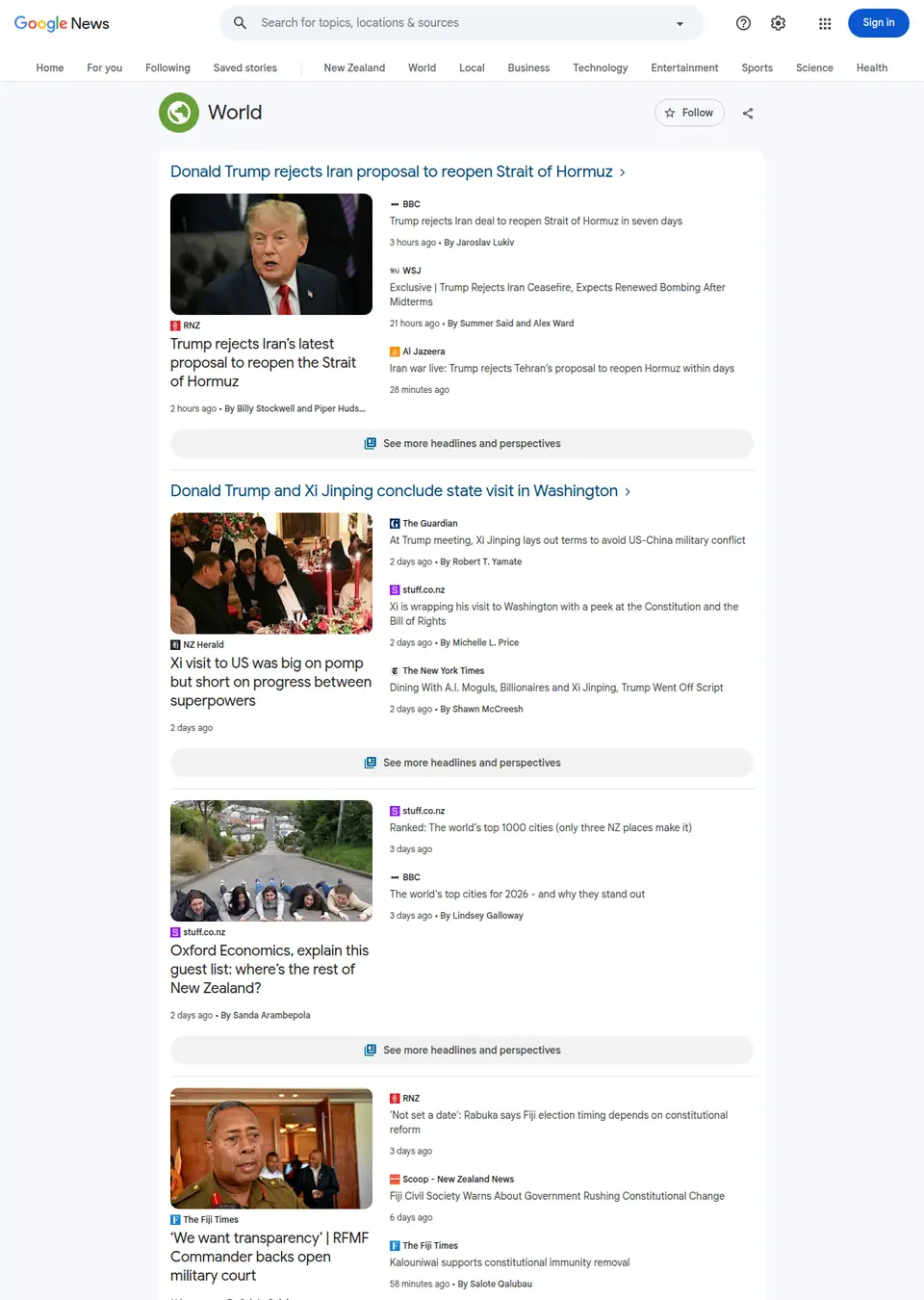
The page on news.google.com that this call reads, as a signed-out visitor sees it. The response below is what Clair returns from it. GET /v1/google-news?topic=WORLD&country=nz · query
{
  "q": null,
  "when": null,
  "topic": "WORLD",
  "topic_token": null,
  "section_token": null,
  "location": null,
  "story_token": null,
  "publication_token": null,
  "language": "en",
  "country": "nz",
  "page": 1
}
Recorded response. Live values differ. 2. Deduplicate across searches
The same story shows up for several terms and markets, sometimes at different URLs. Key on the outlet name plus the title. Each result has the publisher's own url to open and published_at to the second, so you can also drop anything older than your last run.
GET /v1/google-news?topic=WORLD&country=nz · results.0
{
  "position": 1,
  "title": "North Korean operative posing as IT contractor hired by NZ business",
  "url": "https://www.1news.co.nz/2026/09/24/north-korean-operative-posing-as-it-contractor-hired-by-nz-business/",
  "google_url": "https://news.google.com/read/CBMiEXAMPLE",
  "source": {
    "name": "1News",
    "domain": "1news.co.nz"
  },
  "published_at": "2026-09-24T17:03:04.000Z",
  "authors": [
    "Ed O'driscoll"
  ]
}
Recorded response. Live values differ. 3. Cover each market
country and language pick the Google News edition. A story in a British outlet may appear only in the gb edition, so search every market you care about.
GET /v1/google-news?topic=WORLD&country=nz · query.country
"nz"Recorded response. Live values differ.
A script to start from
media_monitor.py
# Hourly media monitoring: new Google News headlines for brand terms,
# deduplicated across terms and markets. Keeps seen keys in seen.json.
import json, os, pathlib, requests

API = "https://api.clair.im"
HEADERS = {"Authorization": f"Bearer {os.environ['CLAIR_API_KEY']}"}
TERMS = ['"Acme Corp"', '"Jane Doe" CEO', "acme.com"]
MARKETS = [("en", "us"), ("en", "gb")]
STATE = pathlib.Path("seen.json")
seen = set(json.loads(STATE.read_text())) if STATE.exists() else set()

def headlines(q, language, country):
    # A busy term fills more than one page in an hour; follow next_cursor.
    page = 1
    while page:
        r = requests.get(f"{API}/v1/google-news", headers=HEADERS, timeout=60, params={
            "q": q, "when": "1h", "page": page,
            "language": language, "country": country})
        r.raise_for_status()
        body = r.json()
        yield from body["results"]
        page = body["next_cursor"]

def story_key(item):
    # Outlets syndicate and markets overlap, so key on outlet and headline
    # rather than the URL.
    return f"{item['source']['name'].lower()}|{item['title'].lower()}"

for term in TERMS:
    for language, country in MARKETS:
        for item in headlines(term, language, country):
            key = story_key(item)
            if key in seen:
                continue
            seen.add(key)
            print(f"[{item['source']['name']}] {item['title']}\n  {item['url']}")

STATE.write_text(json.dumps(sorted(seen)))
Set CLAIR_API_KEY to your Clair key; one plan covers the Google News API. Each call spends that API's rate from the plan's monthly balance.
What it costs per month
| Schedule | Requests | Plan | Per month | Per 1,000 |
|---|---|---|---|---|
| 3 terms × 1 market, hourly3 searches × 24 hours × 30 days = 2,160 requests. | 2,160 | Starter | $30 | $13.89 |
| 3 terms × 2 markets, every 3 hours6 searches × 8 runs × 30 days = 1,440 requests, with when=1d. | 1,440 | Starter | $30 | $20.83 |
| 10 terms × 1 market, daily10 searches × 30 days = 300 requests, with when=1d. | 300 | Starter | $30 | $100 |
| 20 terms × 3 markets, hourly60 searches × 720 hours = 43,200 requests. | 43,200 | Advanced | $300 | $6.94 |
What to plan for
- Headlines only. Google News links to the publisher; for article text, read Reuters, AP, or Bloomberg stories with their APIs, or fetch the publisher page yourself.
- Search reaches 10 pages of about 10 results. With when=1h that covers most terms; a very common term returns the most relevant stories, not all of them, so make terms specific. Each extra page is one more request.
- When Google blocks a request, the API returns scrape_failed rather than older results. After a failed run, search the next one with when=1d so the missed hour is covered; the seen keys drop the repeats.
- This is a headline feed to read, not a screening tool. A capped search can miss stories, so do not rely on it where a missed mention has legal or compliance weight.
- Google News covers outlets it indexes. Trade blogs, newsletters, and social posts are mostly not there.
Common questions
How quickly do new stories appear?
As fast as Google News indexes them, often within minutes for major outlets. An hourly check catches most stories within the hour.
Can I get sentiment?
Not from the API. Pass the title, or the article text where you have it, to your own classifier or a language model.
Does it cover non-English news?
Yes. Set language and country to the edition, such as de and de for German news in Germany.